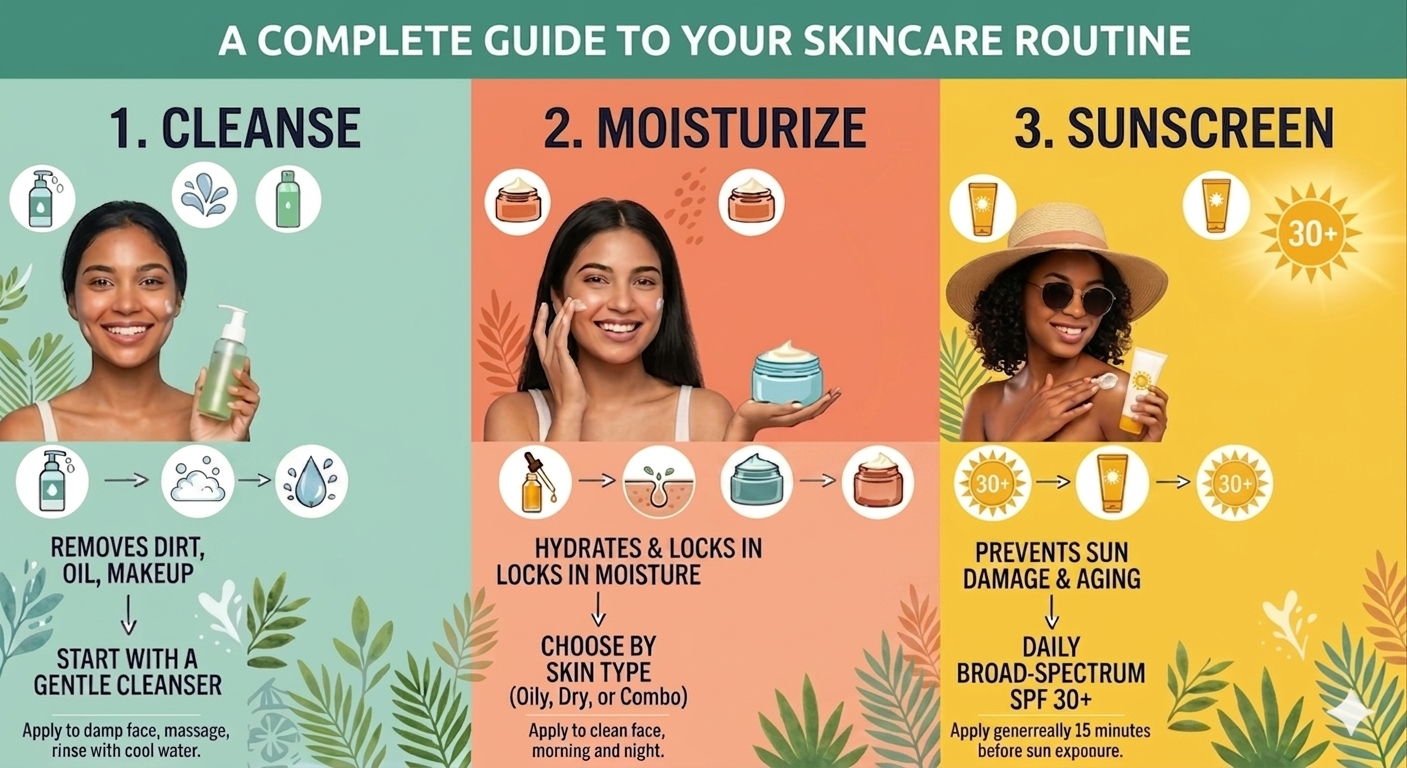
Have you ever felt confused in this era of social media about skincare routines? One day it is a 10-step routine, and the next day it is just one product. If this is your situation, you are in the right place.
You do not need multiple products to have healthy and clear skin. A basic routine is enough for most people. This includes a cleanser, moisturizer, and sunscreen. Anything beyond this is only needed if there are specific concerns such as acne, pigmentation, wrinkles, or scars. In such cases, targeted active ingredients can be added — ideally after consulting a dermatologist. Let's decode this one by one.
Cleansers
Cleansers are products that help remove dirt, sweat, oil, pollutants, and microorganisms from the surface of the skin. They work using surfactants, which help lift oil and dirt so they can be washed away.
A good cleanser should clean effectively without damaging the skin or altering its natural pH.
There are different types of cleansers available:
Soap-based cleansers — Traditional soaps are alkaline in nature, which can cause excessive dryness. Best avoided, especially for dry, sensitive, or acne-prone skin.
Syndet cleansers — Soap-free, pH-balanced cleansers that are gentle on the skin. Suitable for all skin types, especially sensitive skin.
Gel cleansers — Lightweight with mild foaming properties. Best for oily and acne-prone skin.
Foaming cleansers — Contain higher surfactant activity, allowing for deeper cleansing. Good for oily skin, but should be used cautiously on dry or sensitive skin.
Cream cleansers — Rich in emollients that help maintain hydration. Best for dry, sensitive, and mature skin.
Micellar water — Contains micelles that trap dirt without requiring rinsing. Best for light cleansing or post-procedure care.
Moisturizers
One thing I hear very often is, "Do I really need a moisturizer? My skin is already oily." And this is where most people go wrong. Moisturizers are not just for hydration — they also help in maintaining the structure of the skin.
Choosing the right moisturizer for your skin type is important. Broadly, they are grouped based on their composition and texture:
Humectant-based — Ingredients like glycerin and hyaluronic acid help draw water towards the skin. Best for dehydrated and oily skin.
Emollient-based — Ingredients like ceramides and fatty acids give the skin a smooth texture and support the skin barrier. Best for dry skin.
Occlusives — Ingredients like petrolatum and dimethicone form a protective layer over the skin. Best for very dry and damaged skin.
Sunscreens
Sunscreens protect the skin from the harmful effects of sun exposure and other sources of damaging light. Regular use helps prevent tanning, pigmentation, premature ageing, and reduces the risk of skin cancers.
Sunscreens are broadly of two types. Physical (mineral) sunscreens work by reflecting UV radiation, while chemical sunscreens absorb UV rays and convert them into heat. There is also a third category often referred to as oral sunscreens, which are essentially antioxidants that help reduce photodamage — but these do not replace topical sunscreens.
When choosing a sunscreen, opt for a broad-spectrum formulation that protects against both UVA and UVB rays, with an SPF of at least 30, preferably water-resistant. For adequate protection, apply about ½ teaspoon (approximately 2–3 mL) for the face and neck, which roughly corresponds to the amount along the length of the index and middle fingers. Lip protection is also important — use a lip balm with SPF 30 or higher.
The amount applied varies slightly with formulation. Creams, gels, and lotions follow the same quantity guidelines. Stick sunscreens require multiple passes (at least 4 swipes per area) to avoid underapplication. Spray sunscreens should be applied until a visible uniform sheen appears and then spread evenly with the hands.
Reapplication is equally important. Sunscreen should be reapplied every 2 hours when outdoors, and immediately after sweating or swimming.
One of the most common questions is, "Do I really need sunscreen if I am mostly indoors?" The answer is yes. Sunscreen is still necessary indoors and even on cloudy days, as UVA rays can penetrate through windows and clouds, contributing to long-term skin damage.